
Repairing or Renovating an Airbnb With Guests Booked: What We’ve Learned
After nearly 10 years of renting our lake house, we’ve dealt with broken appliances, emergency repairs and now a major exterior renovation—all while guests were staying or scheduled to arrive.
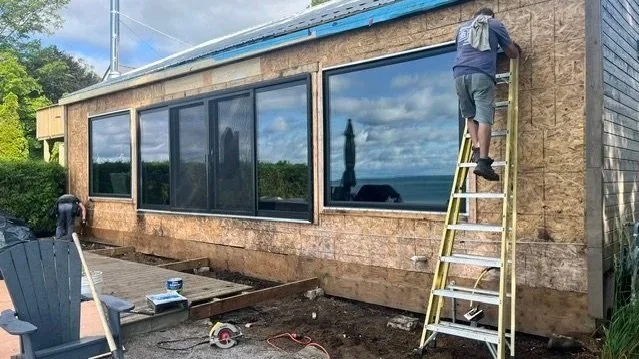
This wasn't exactly how we'd planned to spend our summer. What started as a leaking back window eventually meant removing the siding from both the front and back of the lake house and dismantling the front porch—with guests already booked throughout the season and a 2.5 week family getaway planned.
This summer, we had guests staying at our lake house when water started leaking through one of the back windows. Not ideal. We knew we needed to deal with it quickly, so we contacted someone to investigate. What initially looked like a relatively contained repair turned into something much bigger once we started opening things up. There was more damage than we expected, the issue wasn't limited to the back of the house, and suddenly we weren't dealing with one leaking window anymore. We were dealing with a fairly major exterior renovation in the middle of our summer rental season.
The siding eventually had to come off both the front and back of the lake house, right down to the builder's wrap. The front porch had to be blown apart so we could address issues underneath it. Contractors needed access to the property, work needed to happen when the weather cooperated and, of course, we already had guests booked throughout the summer. It was a mess, but it also wasn't entirely unfamiliar territory.
We've been renting our family lake house for close to ten years now, and if there's one thing I've learned, it's that houses do not care about your rental calendar. We've had the dishwasher stop working completely while guests were staying there. We've had a dishwasher that technically ran but suddenly wasn't cleaning the dishes properly. We've had the refrigerator start leaking water onto the kitchen floor. We've had the ice maker stop working. We've had the air conditioner stop working, twice. And now we've had water coming through a window turn into an exterior project involving way more than we originally anticipated.
Things break. The challenge when you own a short-term rental isn't figuring out how to make sure they never do. It's figuring out what you're going to do when they inevitably break while someone is paying good money to stay in your beautiful lakefront property.
The Guest's Vacation Is Still the Priority
I think this is the most important thing to remember when something goes wrong at a rental property. For us, a broken air conditioner is a property-management problem. We need to find a repair company, arrange access, figure out what's wrong and pay the bill. For the family staying at the lake house, though, it's happening during their vacation. That's a very different perspective. They may have waited all year for this week. They may have taken time off work, packed up their kids and groceries, driven several hours and spent a significant amount of money to stay there. They don't really care that our regular HVAC company can't come until next Tuesday—and they shouldn't have to.
That doesn't mean it's always possible to have something repaired immediately. Sometimes parts need to be ordered. Sometimes contractors aren't available. Sometimes the problem is much bigger than anyone initially realized, as we've certainly discovered this summer. But we've always felt that our responsibility is to do everything reasonably possible to solve the problem as quickly as we can while causing as little disruption to the guests as possible. Sometimes that costs more, and that's simply part of owning a rental property.
Respond First. Figure Out the Rest Second.
One of the biggest things I've learned from dealing with all of these problems is that you don't necessarily need to have the answer immediately, but you do need to respond immediately. If a guest messages to say there's water leaking out of the refrigerator, I don't want them wondering for three hours whether I've even seen the message. The same applies if the dishwasher isn't cleaning properly, the air conditioning has stopped working or there's water coming through a window. I want them to know that I know.
Usually my first response is simply an acknowledgement that we've received their message, we're sorry they're dealing with it and we're working on getting someone there. Then we start making calls. If I don't have an answer right away, I'll update them anyway. There is a huge difference between waiting several hours for a repair while the owner is communicating with you and waiting several hours while wondering whether the owner is doing anything at all.
Over the years, I've found that most guests are actually quite understanding when something goes wrong. They own or rent houses too. Their appliances have broken. They've had furnaces stop working and refrigerators leak. They understand that things happen. What understandably frustrates people is feeling as though the person responsible for the property isn't taking the problem seriously.
Having People You Can Call Matters
One of the less interesting but very practical parts of owning a short-term rental is developing relationships with people who can help you when something goes wrong. An appliance repair person who does excellent work but can't get there for ten days isn't necessarily very useful when your dishwasher stops working at the beginning of a week-long rental. The same goes for HVAC companies, plumbers, electricians and general contractors. We've learned that when guests are in the house, availability and reliability matter almost as much as price.
Over time, it helps to know who actually answers the phone, who will make an effort to fit you in and who you trust to go into the property when you aren't there. We don't have a perfect contractor for every possible problem, and there have certainly been times when we've had to start calling around, but having a handful of dependable people makes an enormous difference when something happens unexpectedly. A repair that might ordinarily wait a week often can't when it is affecting someone else's vacation.
Coordinate the Repair Around the Guests Whenever You Can
Getting someone to the property is only half the problem. Now you have to get them inside. If the repair requires access to the house, I always try to coordinate it with the guests rather than simply telling them that a repair person is coming at a particular time. Maybe they're planning to be at the beach that afternoon. Maybe they're going out for lunch. Maybe they're happy to have someone come first thing in the morning so they can get on with their day.
Obviously, there are limits. If the only HVAC technician who can get there for three days says he can come at 11:00 a.m., there may not be much flexibility. In that situation, we may also end up paying more than we ordinarily would because getting the problem dealt with quickly matters more than finding the least expensive option. But even when timing is limited, communication makes an enormous difference. The goal is to find the best overlap between when the repair person can actually get there and when it will cause the least disruption to the guest. For a small repair, that's usually manageable. For a major renovation, it gets considerably more complicated.
What We've Done During a Major Renovation
This summer, the biggest challenge hasn't really been deciding whether the work needs to happen. Once we understood the extent of the damage, it was obvious that it did. The difficult part has been figuring out how to keep that work moving while we still had a calendar of summer rentals to honour.
One advantage we had was that our own family was spending almost three weeks at the lake house this summer. Rather than trying to keep the property perfectly peaceful for ourselves, we used our own vacation time as an opportunity to get as much of the disruptive work completed as possible. We had contractors working at the lake house while we were there, and there were days when people were coming and going and construction was happening around us. Was that how I would ideally choose to spend three weeks at the lake? Not particularly. But I'd much rather have the contractors disrupt our vacation than someone else's.
When our stay ended and paying guests returned, we tried to pause the work that would significantly interfere with their time at the lake house. Of course, construction doesn't always fit neatly between checkout and check-in, and that creates another problem: sometimes stopping the work means leaving the house looking unfinished. That's essentially where we've found ourselves this summer. There have been periods when work couldn't continue while guests were there, but the exterior wasn't magically finished just because the contractors went home. At that point, there's no clever hosting trick that makes the situation disappear. You have to tell people the truth.
If You Know About a Problem, Tell Guests Before They Arrive
I would much rather have an uncomfortable conversation with a guest before their trip than have them pull into the driveway and discover something they weren't expecting. If we know the exterior of the lake house is going to be partially under construction when someone arrives, they need to know that. That means explaining what's happening, what the property currently looks like, whether contractors will be present during their stay and, most importantly, how we expect it to affect their actual use of the lake house.
I think specificity matters here. "Some exterior work is underway" can mean almost anything. If siding has been removed from the house, I think the guest deserves to know that siding has been removed from the house. It may be tempting to minimize the problem because you don't want someone to cancel, but I think that creates a much bigger problem if they arrive feeling that you deliberately withheld information. We try to be very clear about what's happening and then figure out what we can reasonably offer to make up for the inconvenience.
Sometimes You Need to Compensate People
Communication is important, but there are situations where good communication isn't enough. If someone booked and paid for a particular experience and something significant has changed, I think you have to acknowledge that financially as well. With the larger work we're dealing with this summer, we've offered concessions such as a reduced rental price and, in some cases, complimentary time at the lake house in the future when the work is complete.
There isn't one percentage or formula that I think applies to every situation. A dishwasher that stops working on the last night of a stay is very different from a broken air conditioner during a heat wave. And both are very different from arriving at a lake house where part of the exterior has been stripped back to the builder's wrap. I tend to come back to a fairly simple question: If I were the person who had paid for this vacation, what would I think was fair?
Sometimes the answer costs us money, and that's okay. We've always approached renting the lake house with the idea that we're willing to lose a dollar in the short term if that's what it takes to do right by a guest. A partial refund costs money. An emergency repair call costs money. Offering someone a couple of complimentary days the following year means giving away nights we could potentially rent. But squeezing every possible dollar out of one particular reservation has never been our goal. We want people to have a good experience at the lake house, and when something outside their control interferes with that experience, I think it's reasonable for us to absorb some of the cost.
Don't Make the Guest Chase You
There's another small thing that I think makes a big difference when you're in the middle of a repair: keep communicating even when there's nothing particularly exciting to report. If I've told a guest I'm trying to get someone out to look at the air conditioner, I don't want them to have to message me four hours later and ask whether I've found anyone. I'll tell them. If the technician says he'll be there between two and four, I'll pass that along. If he's running late, I'll update them. If the repair couldn't be completed because a part needs to be ordered, I'll explain what happens next.
The same principle applies to a renovation that you know about in advance. Tell guests what they should expect before they arrive. If something changes, tell them. If the contractor no longer needs to come during their stay, that's worth telling them too. I don't think guests expect perfection nearly as often as hosts fear they do. They do expect to know what's going on.
This Is Part of Owning a Short-Term Rental
I think it's easy to talk about short-term rentals in terms of bookings, nightly rates, cleaning fees and occupancy. But underneath all of that, you're still responsible for maintaining a house, and eventually that responsibility is going to collide with a reservation. You can stay on top of regular maintenance and try to anticipate problems, but you can't schedule every repair neatly between guests or guarantee that nothing unexpected will happen during someone's stay.
After close to ten years of renting our lake house, I don't think preventing every problem is a realistic goal. What we can control is how we respond when something happens: how quickly we answer, how seriously we take the problem, how much effort we make to minimize the disruption and whether we're honest and fair with guests when their stay isn't quite what anyone expected it to be.
Most guests understand that houses aren't perfect. In our experience, what matters much more is knowing that when something does go wrong, the person on the other end of the message cares about fixing it. After almost ten years of managing repairs both big and small, that's probably the biggest lesson we've learned: you don't have to promise guests that nothing will ever go wrong. You just have to show them that when it does, you're going to deal with it.